
Restoring Function, Airway, and Confidence After Severe Tooth Wear
Over time, they had become shorter, worn down, and uneven. There were spaces between them that hadn’t been there before, and food would frequently get trapped. Maintaining them had become increasingly difficult, despite his efforts.
From his perspective, this was primarily a cosmetic issue.
“I was unhappy with how my teeth looked,” he explained. “I just felt like it was time to get things back in order.”
He had recently made several lifestyle changes and saw this as part of a broader effort to improve his overall health.
What he didn’t realize at the time was that the visible changes in his teeth were only part of a much larger pattern.
His teeth had worn down past their natural contact points—what we refer to as the “height of contour.” This level of wear doesn’t happen randomly. It is typically the result of long-standing muscular imbalance and functional strain within the jaw.
As the teeth wear down, the relationship between the upper and lower jaw changes. In John’s case, his lower jaw had shifted into a position that was too close to the upper jaw when his back teeth came together.
This is what we describe as a functional collapse of the bite.
When that happens, the muscles of the head and neck are forced to shorten in order to bring the teeth together. Over time, this leads to chronic muscle tension and accelerated grinding.
There was also another important piece.
As the jaw collapses, the available space for the tongue decreases. When that space is reduced, the tongue is pushed backward toward the airway.
That pattern is frequently associated with sleep-disordered breathing.
He had never considered that his dental condition and his sleep might be connected.
“I had no idea I had sleep apnea,” he said. “They were the ones who found it.”
A sleep study confirmed that he had mild obstructive sleep apnea.
For many patients, this is the moment where things start to make sense—not just what is happening, but why it has been progressing over time.
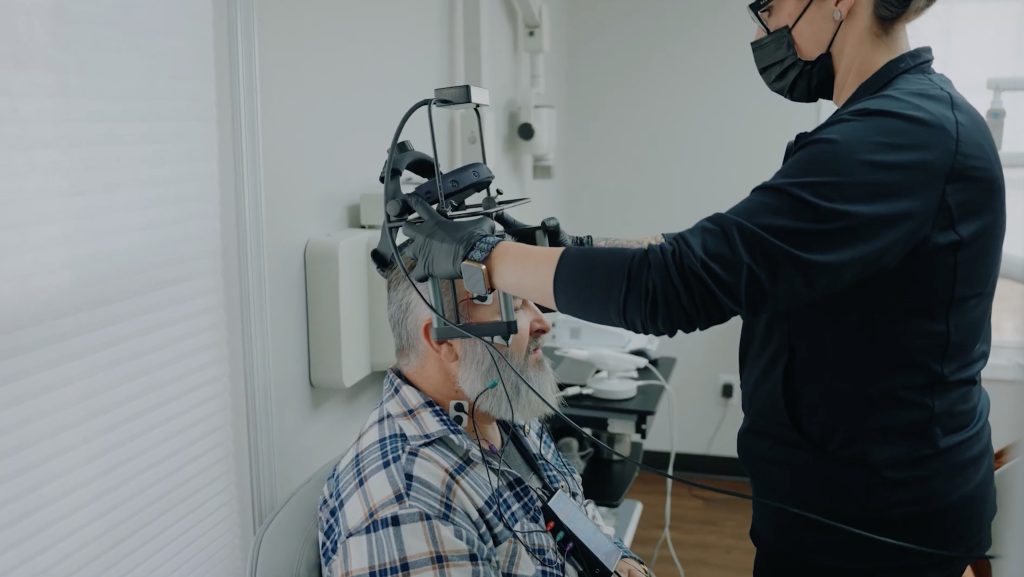
The first phase involved a comprehensive diagnostic process, including:
This allowed us to determine a new, physiologic jaw position—one that would allow the muscles to relax, the joints to function properly, and the airway to remain open.
This is a transitional phase that allows us to:
It also gives the patient an early preview of how their final smile will look and feel.
For John, this phase made an immediate impact.
From the first day, he noticed a difference in comfort. And just as importantly, he began to feel more confident in his appearance.
Using the data collected during the evaluation and trial phase, a custom smile design was created in collaboration with a dental laboratory. The goal was not only to restore the teeth, but to do so in a way that matched John’s facial features and functioned within the newly established jaw position.
The final restorations were completed in stages:
By working in phases, we were able to maintain precision while keeping the process manageable and comfortable.
“My quality of life has changed tremendously,” John shared.
He reported:
There was also a noticeable shift in confidence.
“I didn’t realize that for years I wasn’t smiling,” he said. “Now I’m smiling everywhere I go.”
That is something we hear more often than people might expect.
When patients have spent years adapting—whether physically or emotionally—it takes time to adjust to feeling comfortable again.
It is possible to improve the appearance of teeth without addressing the underlying function. But when the bite, muscles, and joints are not in balance, those problems tend to persist—or return in different ways.
By focusing first on physiologic stability, we are able to create outcomes that are not only aesthetic, but also durable and comfortable.
These may not be isolated issues.
They are often connected.
Understanding that connection is the first step toward addressing it.
Our Latest Patient Stories
- 3D CBCT imaging to evaluate joint position and airway volume
- Jaw tracking to analyze movement patterns
- Electromyography (EMG) to assess muscle activity
- Digital scans and photographs for functional and aesthetic planning
- Test the new jaw position
- Confirm that symptoms improve
- Ensure that the patient can comfortably function in that position
- Upper teeth first, to establish the foundation of the smile
- Lower teeth second, to complete the functional system
- Improved sleep
- Reduced snoring
- Increased energy in the morning
- Greater overall comfort
- Teeth becoming shorter or more worn over time
- A bite that feels different or unstable
- Increased clenching or grinding
- Sleep issues or fatigue without a clear explanation
When the Problem Doesn’t Feel Like a “Dental Problem”
John initially came to Tuscarora Dental with a concern that many patients can relate to—he didn’t like the way his teeth looked.
What the Initial Evaluation Revealed
During John’s comprehensive evaluation, the wear patterns on his teeth told a very specific story.
Connecting the Dots
When we began asking John about his sleep, something stood out immediately.
A Different Approach to Treatment
Rather than beginning with the teeth themselves, treatment started with understanding and stabilizing the underlying system.
The Trial Phase
Before moving into permanent restorations, John was placed into a fixed physiologic orthotic.
Transitioning to Final Restorations
Once stability was confirmed, we moved into the restorative phase.
Changes Beyond the Smile
The outcome of treatment extended well beyond aesthetics.
A Common Theme
One of the more meaningful things John shared was that he felt like he had to “learn how to smile again.”
What This Case Represents
This case highlights an important distinction in dentistry.
For Patients in a Similar Situation
If you have noticed changes such as:
Rebuilding Function and Confidence After Tooth Loss
Terri’s journey to treatment began with a series of challenges that many patients face. After dealing with a toothache, she underwent significant dental work that resulted in the removal of multiple teeth.